Introduction
In the realm of Kubernetes and cloud-native technologies, GitOps has emerged as a powerful approach to managing and automating the deployment and operation of applications. GitOps leverages the principles of version control and collaboration from Git, combined with Kubernetes declarative capabilities, to achieve continuous delivery and operational efficiency. In this blog post, we will explore the best practices for implementing GitOps in Kubernetes, enabling teams to streamline workflows, ensure consistency, and achieve a secure and resilient application deployment.
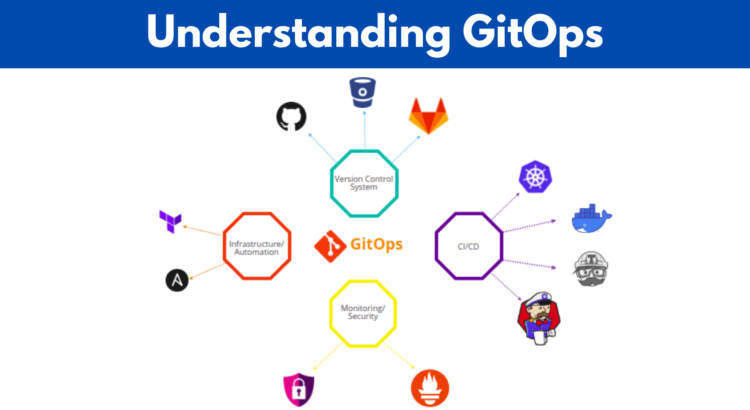
Understanding GitOps
GitOps is a set of practices that leverage Git as the single source of truth for defining the desired state of the Kubernetes cluster and applications running within it. The core principles of GitOps are as follows:
-
Declarative Configuration: All configuration for Kubernetes resources is stored in version-controlled Git repositories as code, making it easy to track changes, collaborate, and review.
-
Automated Synchronization: The desired state defined in Git is automatically synchronized and applied to the Kubernetes cluster using continuous integration and continuous delivery (CI/CD) pipelines.
-
Observability and Rollbacks: GitOps emphasizes observability by providing clear audit trails of changes. Rollbacks are made straightforward by reverting to a previous Git commit.
Best Practices for GitOps in Kubernetes
-
Infrastructure as Code (IaC): Implement Infrastructure as Code (IaC) principles to define Kubernetes resources, configurations, and policies in code format using tools like Terraform or Kubernetes YAML manifests. IaC makes it easier to manage, version, and review changes to the cluster infrastructure.
-
Git Repository Structure: Organize your Git repository with separate directories for each application, along with corresponding Kubernetes resource definitions and configuration files. This structure fosters clarity and simplifies navigation within the repository.
-
Immutability: Treat the Kubernetes cluster as immutable. Changes should only be made through the Git repository, ensuring consistency and eliminating ad-hoc changes. This principle enhances reliability and reproducibility.
-
Kubernetes Operator: Leverage Kubernetes Operators or custom controllers to define application-specific operational logic within your GitOps workflow. Operators encapsulate domain knowledge and provide higher-level abstractions for managing applications.
-
Pull-Based Model: Use a pull-based approach for synchronization, where the Kubernetes cluster continuously pulls the desired state from the Git repository, rather than relying on external agents to push configurations. This model ensures that the cluster is always in sync with the Git repository.
-
Secret Management: Handle sensitive information, such as API keys or passwords, separately using Kubernetes Secrets or external secret management tools like HashiCorp Vault. Securely managing secrets is crucial to maintaining the integrity of the system.
-
RBAC and Access Control: Implement Role-Based Access Control (RBAC) to restrict access to the Git repository and cluster configurations, ensuring secure and controlled changes. This helps prevent unauthorized modifications to critical resources.
-
Automated CI/CD Pipelines: Set up automated CI/CD pipelines that trigger Kubernetes deployments upon changes to the Git repository, providing seamless updates. Automated pipelines promote consistency and eliminate manual intervention.
-
Testing and Validation: Incorporate automated testing and validation into your CI/CD pipelines to catch errors early and maintain high application quality. Automated testing helps ensure that changes work as expected before being deployed to the cluster.
-
Monitoring and Observability: Implement monitoring and observability tools to gain insights into the cluster’s health and application performance. Monitoring facilitates rapid detection and resolution of issues, promoting a proactive approach to maintenance.
-
Continuous Improvement: Encourage a culture of continuous improvement by regularly reviewing Git commit history, analyzing failures, and seeking feedback from team members to optimize the GitOps workflow. Continuous improvement fosters agility and adaptability.
Conclusion
GitOps has become a game-changer for Kubernetes application deployment and management. By leveraging Git as the single source of truth and automating synchronization through CI/CD pipelines, GitOps empowers teams to achieve continuous delivery, maintain consistency, and facilitate collaboration. By following best practices like Infrastructure as Code, immutability, RBAC, and automated testing, organizations can establish a robust and secure GitOps workflow for their Kubernetes environments. With GitOps, teams can confidently manage Kubernetes applications, promote a culture of automation, and ensure a resilient and efficient operation of their cloud-native infrastructure. Embracing GitOps in Kubernetes brings the benefits of version control, scalability, and observability, making it a crucial technique for modern software and infrastructure management.